
A short history of genetic testing: from the Human Genome Project to today
Recent Posts




Related Posts


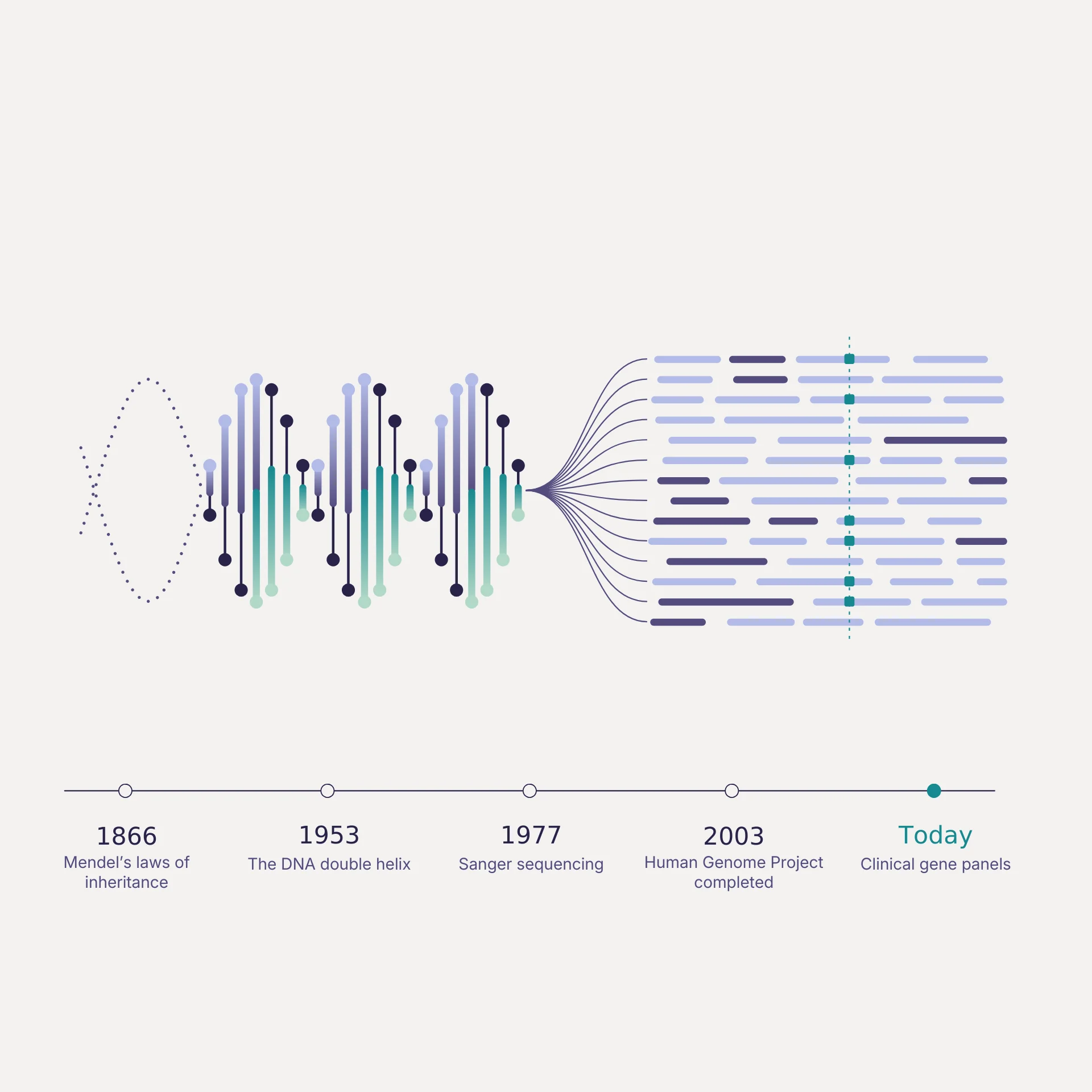
The history of genetic testing is a story of moving from one gene at a time to hundreds, and from explaining illness to preventing it. Seventy years ago, scientists had only just worked out the structure of DNA. The Human Genome Project, which ran from 1990 to 2003, then produced the first reference sequence of human DNA and set off a steep fall in the cost of sequencing.1 Today, reading DNA no longer takes years or costs millions, and a clinical test can begin with a simple cheek swab, also known as a buccal swab, collected at home. For Genotype Health’s founder, it is also a personal story, which you can read in full in our founder story.
Key takeaways
- Before the 1990s, genetic tests looked at one gene at a time and were mainly offered to families already affected by a condition.
- The Human Genome Project (1990 to 2003) produced the first reference sequence of human DNA, and next-generation sequencing from 2008 cut the cost of reading a genome from millions of dollars to under US$1,500 by 2015.
- Testing has since shifted towards prevention, with Australian studies finding about 1 in 50 healthy young adults carry a variant linked to a preventable condition.
- A result can gain meaning over time. A variant recorded as being of unknown significance in 2010 can be well understood today.
- AI is speeding up interpretation, but it learns from data that is not yet equitable, so human oversight and more representative data both matter.
What is the history of genetic testing, in brief?
Genetic testing is a laboratory test that reads a person’s DNA to look for variants that may explain a health condition or point to a higher chance of developing one. The history of genetic testing falls into three broad chapters. In the first, which lasted until the 1990s, scientists could study only single genes, slowly and at great expense. The second was the Human Genome Project itself, an international effort to read the entire human DNA sequence. The third, which is still unfolding, began when new technology made sequencing fast and affordable enough to become part of everyday healthcare. Each chapter changed who could be tested, what a test could show and what people could do with the answer.
For Genotype Health’s founder and CEO, Mimi Zilliacus, this history is also personal. She was born in the early 1980s and has lived through each of these chapters as a patient, so her own experience is told in her words alongside the timeline.
What did genetic testing look like before the Human Genome Project?
The foundations were laid in 1953, when the double-helix structure of DNA was described.2 Practical testing followed gradually. From the 1960s, newborn bloodspot screening was offered to babies across Australia, and the program now reaches about 99% of babies each year.3 In 1977, the first methods for reading DNA sequence were established, and in 1983 two further advances arrived together: the gene region for Huntington’s disease was mapped, and the polymerase chain reaction (PCR), a way of copying small amounts of DNA, was invented.2
These tools allowed researchers to find individual genes. The cystic fibrosis gene was identified in 1989, and the first gene linked to hereditary breast cancer, BRCA1, followed in the mid-1990s.2 However, each discovery took years of work, and each test examined a single gene. As a result, genetic testing in this period was largely reserved for families who already had a known condition, and it offered little to people who simply wanted to understand their own risk.
Many conditions could not be tested for at all, because the genes behind them had not yet been found. Noonan syndrome, which affects about 1 in 1,000 to 2,500 people and often involves the heart,4 is one example. Its first gene was not identified until 2001,5 so anyone diagnosed before then was diagnosed on clinical signs alone.
“I was born in the early 1980s and diagnosed with Noonan syndrome based on my clinical presentation. At the time, that mostly meant issues with my heart, although we also knew that my joints were ‘floppy’.”
Mimi Zilliacus, Founder and CEO, Genotype Health
What was the Human Genome Project, and why did it matter?
The Human Genome Project officially began in October 1990, with the aim of reading the full sequence of human DNA.6 It grew into a major international collaboration, involving researchers in six countries: the United States, the United Kingdom, France, Germany, Japan and China. Work was shared across laboratories, including 20 universities and research centres in the United States alone, and the project carried a projected budget of about US$3 billion. A draft covering about 90% of the genome was announced in June 2000, and the project was completed in 2003, two years ahead of schedule, with a sequence covering about 92% of the genome.1
Three features of the project shaped everything that followed. First, it gave scientists a reference sequence, a standard against which any person’s DNA could be compared. Second, the project made its data freely and rapidly available, a practice that changed how research is shared. Third, it funded work on the ethical, legal and social questions that genetic information raises, including privacy and fair treatment.1 The project also had a limitation that still matters today. The reference sequence was built from the DNA of a small group of anonymous volunteers,1 so it could not capture the diversity of the world’s populations. This is one reason genetic data has been slower to represent everyone equally, as we explain in genomic equity.
While the project was under way, genetics remained a specialist field that most patients rarely encountered, and knowledge of rarer conditions was thin outside a small number of clinics.
“When I was around 16, I saw a clinical geneticist about some persistent and unexplained symptoms, and he told me it was lymphoedema, which was common with Noonan syndrome. For most of my life, though, it was rare to find a doctor who knew what Noonan syndrome involved or who took my genetics into account.”
Mimi Zilliacus, Founder and CEO, Genotype Health
How did sequencing become fast and affordable?
The first human genome was extraordinarily expensive. The United States National Human Genome Research Institute estimates that producing it cost between US$500 million and US$1 billion, and by 2006 a comparable draft still cost about US$14 million.7 The turning point came in 2008, when sequencing centres moved from the original method to next-generation sequencing, which reads millions of DNA fragments at the same time.8 Costs then fell far faster than anyone had predicted. By mid-2015, a high-quality draft of a whole human genome cost just over US$4,000, and by the end of that year it had fallen below US$1,500.7
This change transformed clinical testing. Instead of examining one gene, laboratories could read panels of dozens or hundreds of genes in a single test, at a price that health systems and individuals could afford. Faster sequencing also created a new challenge, because reading DNA is only useful if the findings are interpreted consistently. In 2015, international standards were published for classifying variants, using categories that range from benign to pathogenic, and these remain the basis for clinical reporting.9 Our guide to understanding your genetic test report explains these categories.
Interpretation also improves with time. When there is not yet enough evidence to say whether a variant affects health, it is recorded as a variant of uncertain, or unknown, significance, and it can be reclassified as knowledge grows.10
“In 2010 I had genetic testing that identified my variant. At the time it was noted as a variant of unknown significance. Its significance is now well established.”
Mimi Zilliacus, Founder and CEO, Genotype Health
Where do consumer DNA kits fit into this story?
As costs fell, companies also began selling DNA tests directly to the public, often for ancestry or lifestyle traits. These tests are different from clinical testing. In 2014, Australia’s National Health and Medical Research Council noted that only a small minority of consumer genetic tests had established clinical value, and it encouraged people to involve health professionals such as genetic counsellors in the testing process.11 See what makes a genetic test clinical-grade.
When was the human genome actually finished?
Although the Human Genome Project ended in 2003, some regions of DNA were too repetitive for the technology of the time. The gaps were finally closed in 2022, when an international team published the first complete sequence, filling in the remaining 8% of the genome and adding nearly 200 million letters of DNA.12
How has the history of genetic testing changed screening for healthy people?
Perhaps the most important shift in the history of genetic testing is the move from diagnosis to prevention. Once testing became affordable, researchers could ask a new question: what happens when healthy people are offered screening? In Australia, the DNA Screen study tested 10,263 adults aged 18 to 40 and found that about 1 in 50 carried a variant linked to hereditary cancer or high cholesterol, conditions that can be prevented or managed when found early. Around half of those with a cancer-related variant had no close family history, which means they would not have been identified by family history alone.13 Similarly, Mackenzie’s Mission screened more than 9,000 couples and found that about 1 in 50 had an increased chance of having a child with a serious genetic condition.14
Policy has moved alongside the science. Medicare now funds carrier testing for cystic fibrosis, spinal muscular atrophy and fragile X syndrome for people who are pregnant or planning a pregnancy.15 In 2025, the Australian Government established Genomics Australia to provide national leadership on bringing genomics into the health system,16 and from 8 October 2026 life insurers can no longer use adverse genetic test results to deny or limit cover.17 Together, these changes mean that someone considering a test today has more protection and more support than at any earlier point.
“A generation ago, testing a single gene could take months and was offered only to families already living with a condition. Today the same science lets healthy people plan ahead, and that is a remarkable change in a short time.”
Dr Matt Edwards, Clinical Geneticist, Genotype Health
How is genetic testing developing in Southeast Asia?
Because early genomic research drew so heavily on people of European ancestry, the reference data used to interpret results has been less complete for other populations.18 Countries across Southeast Asia are now addressing this directly. Thailand launched its Genomics Thailand initiative in 2019, with a plan to sequence the genomes of 50,000 Thai people and build the infrastructure to use that information in healthcare.19 Indonesia followed in August 2022 with the Biomedical and Genome Science Initiative, its first national program of this kind, which covers cancer, infectious diseases, metabolic conditions and genetic disorders.20 As these programs grow, tests can be interpreted with greater confidence for the people they serve, which is central to Genotype Health’s focus on population-tailored screening.
What does the genetic testing process look like today?
Seen against the history of genetic testing, the process today is strikingly simple. With Genotype Health, it begins with a conversation with Tara, our AI assistant, which provides general information about the screens available. A kit is then posted out, and the sample is collected at home using a simple cheek swab, also known as a buccal swab. The laboratory reads the genes on the chosen panel using diagnostic-quality sequencing, and results are delivered securely online in about four weeks.
The screens themselves reflect how far the field has come. Prevonco looks at genes linked to hereditary cancer, Cordagen at inherited heart conditions, Omnagen at a broad range of medically actionable conditions, and Lineova at carrier status for people planning a family. It is worth remembering that a screening result shows an increased risk and is not a diagnosis of disease. For this reason, a genetic counsellor explains any positive result and the practical steps that follow.
What about diagnostic testing?
Screening is only one part of modern genetic testing. Genotype Health also provides diagnostic testing services for people with symptoms, a strong family history or a known variant in the family. A diagnostic test is targeted, which means it looks for specific variants that are suspected because of someone’s clinical picture or their family’s history of disease. It can help explain symptoms and tailor treatment, although it is not always a diagnosis of disease on its own. Diagnostic tests are generally available on referral from a specialist doctor, and Family Variant Testing, which looks for a variant already identified in a family, is also arranged by referral. Anyone unsure which path fits their situation can speak with a genetic counsellor first, and those with a strong family history can check the directory of public genetic services across Australia for government-funded options.
What comes next for genetic testing?
The direction of travel is towards testing that is more routine, more representative and more closely tied to prevention. National bodies are working to bring genomics into everyday care,16 and regional programs are widening the range of people represented in reference data.19,20 Even so, some things have not changed. A result still needs careful interpretation, and its meaning depends on personal and family history. A test that finds nothing definitive is not the end of the story either, because understanding keeps moving.
“In 2022 I had further genetic testing to see whether we could find out more about my autoimmune profile. We didn’t find anything definitive, but research and understanding have been progressing at an accelerating rate, particularly around what we thought of as my ‘floppy’ joints. We have known for almost a decade that my type of Noonan syndrome is linked with problems in the connective tissue, and in the last few years it has become clear that so much of my health profile comes back to collagen production.”
Mimi Zilliacus, Founder and CEO, Genotype Health
How is AI changing genetic testing, and why do people still matter?
The newest chapter is being written by artificial intelligence (AI). Sequencing is now fast, so the slow and costly part of a genetic test is interpretation, and AI tools are beginning to speed up that work. The World Health Organization notes that AI can improve the speed and accuracy of diagnosis and screening,21 and as these tools mature they are expected to bring the cost of testing down further. However, care is needed. AI learns from the data that is available, and that data is not yet equitable. Around 79% of participants in genomic studies are of European descent, although this group makes up only about 16% of the world’s population, and predictions built on that data have been shown to be several times less accurate for people of other ancestries.22 This means AI has the potential to widen existing inequalities unless the underlying data becomes more representative. The World Health Organization makes the same point, warning that systems trained mainly on data from high-income countries may not perform well elsewhere, and it recommends that humans remain in control of medical decisions.21
Genotype Health applies the same principle. Tara provides general information and supports the counselling process, while results are analysed by laboratory scientists and explained by genetic counsellors. Technology can make testing faster and more affordable, but people still need to check the work and stay in the loop. Anyone curious about where they fit in this story can start by chatting with Tara or by booking a consultation with a genetic counsellor.
What else do people ask about the history of genetic testing?
What is the difference between genetics and genomics?
Genetics is the study of individual genes and how traits are inherited. Genomics is the study of all of a person’s DNA, known as the genome, and how genes work together and with the environment.
What is the difference between a gene panel, exome sequencing and genome sequencing?
A gene panel reads a selected set of genes linked to particular conditions. Exome sequencing reads the protein-coding parts of all genes, and genome sequencing reads nearly all of a person’s DNA. Panels are commonly used for screening because they focus on genes where a finding can be acted on. Read more in whole exome vs whole genome sequencing.
How many genes does a modern screening test read?
It depends on the test. Genotype Health’s Cordagen screen reads 95 genes, Omnagen reads 181 genes and the Lineova carrier screen reads more than 460 genes.
Does everyone need whole genome sequencing?
No. For most healthy people, a focused panel of well-understood genes gives clearer and more useful answers than sequencing everything, because results are limited to findings that can guide health decisions.
Is a referral needed for genetic testing today?
Not always. Genotype Health’s proactive and carrier screens can be ordered online, starting with a chat with Tara. Genotype Health’s diagnostic tests and Family Variant Testing are different and are generally arranged on referral from a specialist doctor.
Related reading
- Founder story
- Genomic equity
- Introducing Tara, our AI genetics assistant
- Everything you need to know about genetic testing and counselling
References
- National Human Genome Research Institute. Human Genome Project fact sheet [Internet]. Bethesda (MD): National Institutes of Health; [updated 2024 Jun 13; cited 2026 Oct 2]. Available from: https://www.genome.gov/about-genomics/educational-resources/fact-sheets/human-genome-project
- National Human Genome Research Institute. Landmarks in genetics and genomics [Internet]. Bethesda (MD): National Institutes of Health; 2020 [cited 2026 Oct 2]. Available from: https://www.genome.gov/sites/default/files/media/files/2020-09/HGP_Timeline.pdf
- Australian Government Department of Health, Disability and Ageing. About newborn bloodspot screening [Internet]. Canberra: Department of Health, Disability and Ageing; [cited 2026 Oct 2]. Available from: https://www.health.gov.au/our-work/newborn-bloodspot-screening/about
- MedlinePlus Genetics. Noonan syndrome [Internet]. Bethesda (MD): National Library of Medicine; [updated 2018 Jun 1; cited 2026 Oct 2]. Available from: https://medlineplus.gov/genetics/condition/noonan-syndrome
- Tartaglia M, Mehler EL, Goldberg R, Zampino G, Brunner HG, Kremer H, et al. Mutations in PTPN11, encoding the protein tyrosine phosphatase SHP-2, cause Noonan syndrome. Nat Genet. 2001;29(4):465–8. doi:10.1038/ng772
- National Human Genome Research Institute. NHGRI history and timeline of events [Internet]. Bethesda (MD): National Institutes of Health; [cited 2026 Oct 2]. Available from: https://www.genome.gov/about-nhgri/brief-history-timeline
- National Human Genome Research Institute. The cost of sequencing a human genome [Internet]. Bethesda (MD): National Institutes of Health; [updated 2021 Nov 1; cited 2026 Oct 2]. Available from: https://www.genome.gov/about-genomics/fact-sheets/Sequencing-Human-Genome-cost
- National Human Genome Research Institute. DNA sequencing costs: data [Internet]. Bethesda (MD): National Institutes of Health; [updated 2023 May 16; cited 2026 Oct 2]. Available from: https://www.genome.gov/about-genomics/fact-sheets/DNA-Sequencing-Costs-Data
- Richards S, Aziz N, Bale S, Bick D, Das S, Gastier-Foster J, et al. Standards and guidelines for the interpretation of sequence variants: a joint consensus recommendation of the American College of Medical Genetics and Genomics and the Association for Molecular Pathology. Genet Med. 2015;17(5):405–24. doi:10.1038/gim.2015.30
- Centre for Genetics Education. Variant of uncertain significance (VUS) [Internet]. Sydney: NSW Health; 2021 Oct [cited 2026 Oct 2]. Available from: https://www.genetics.edu.au/PDF/Variant_of_uncertain_significance_(VUS)_fact_sheet-CGE.pdf
- National Health and Medical Research Council. Direct-to-consumer genetic testing: a statement from the National Health and Medical Research Council (NHMRC). NHMRC ref G9 [Internet]. Canberra: NHMRC; 2014 Dec [cited 2026 Oct 2]. Available from: https://www.nhmrc.gov.au/sites/default/files/documents/reports/statement-consumer-genetic-testing.pdf
- Nurk S, Koren S, Rhie A, Rautiainen M, Bzikadze AV, Mikheenko A, et al. The complete sequence of a human genome. Science. 2022;376(6588):44–53. doi:10.1126/science.abj6987
- Lacaze P, Tiller J, Brotchie A, Nguyen-Dumont T, Steen J, Belluoccio D, et al. Feasibility and outcomes of the DNA Screen nationwide adult genomic screening pilot. Nat Health. 2026;1(1):90–8. doi:10.1038/s44360-025-00020-x
- Kirk EP, Delatycki MB, Archibald AD, et al. Nationwide, couple-based genetic carrier screening. N Engl J Med. 2024;391(20):1877–89. doi:10.1056/NEJMoa2314768
- Australian Government Department of Health, Disability and Ageing. Medicare Benefits Schedule: item 73451 [Internet]. Canberra: Department of Health, Disability and Ageing; [cited 2026 Oct 2]. Available from: https://www9.health.gov.au/mbs/fullDisplay.cfm?type=item&q=73451&qt=item
- Australian Government Department of Health, Disability and Ageing. Genomics Australia [Internet]. Canberra: Department of Health, Disability and Ageing; [cited 2026 Oct 2]. Available from: https://www.health.gov.au/our-work/genomics-australia
- Mulino D. Legislation passed to ban the use of adverse genetic testing results in life insurance [Internet]. Canberra: Australian Government, The Treasury; 2026 Apr 1 [cited 2026 Oct 2]. Available from: https://ministers.treasury.gov.au/ministers/daniel-mulino-2025/media-releases/legislation-passed-ban-use-adverse-genetic-testing
- Popejoy AB, Fullerton SM. Genomics is failing on diversity. Nature. 2016;538(7624):161–4. doi:10.1038/538161a
- National Science and Technology Development Agency. Genomic medicine in Thailand [Internet]. Pathum Thani: NSTDA; 2020 Jul 13 [cited 2026 Oct 2]. Available from: https://www.nstda.or.th/en/news/news-years-2020/genomic-medicine-in-thailand.html
- Ministry of Health of the Republic of Indonesia. Biomedical and Genome Science Initiative (BGSi): about us [Internet]. Jakarta: Ministry of Health; [cited 2026 Oct 2]. Available from: https://bgsi.kemkes.go.id/about-bgsi/about-us
- World Health Organization. Ethics and governance of artificial intelligence for health: WHO guidance. Geneva: World Health Organization; 2021. ISBN 9789240029200. Available from: https://www.who.int/publications/i/item/9789240029200
- Martin AR, Kanai M, Kamatani Y, Okada Y, Neale BM, Daly MJ. Clinical use of current polygenic risk scores may exacerbate health disparities. Nat Genet. 2019;51(4):584–91. doi:10.1038/s41588-019-0379-x