
Understanding your genetic test report: a guide to common terms
Recent Posts





Related Posts



A genetic test report explains what the laboratory looked for, what it found and what the finding may mean for health or family planning. Most reports sort each variant into one of five categories (pathogenic, likely pathogenic, uncertain significance, likely benign or benign), describe how the variant is inherited, and use terms such as heterozygous, carrier and penetrance. Understanding these words makes a report much easier to follow, but a result is always best interpreted with a genetic counsellor or doctor, because its meaning depends on personal and family history.1,2 For a wider introduction, see everything you need to know about genetic testing and counselling.
Key takeaways
- Reports classify variants as pathogenic, likely pathogenic, uncertain significance, likely benign or benign, using international standards.
- A variant of uncertain significance is not a positive result and should not be used on its own to make medical decisions.
- Terms such as heterozygous, homozygous and carrier describe how many copies of a variant someone has and what that means for them and their children.
- A negative result reduces the chance of a genetic condition, though it cannot always rule one out.
- Genetic counselling helps turn a report into practical next steps, including testing for relatives.
What does a genetic test report usually include?
Although layouts vary between laboratories, most genetic test reports follow a similar structure. They begin with identifying details and the reason for testing, then name the test performed and the genes analysed. A summary states the main result, followed by details of any variant found, an interpretation of what it means, recommendations for next steps and a section on the test’s limitations. Because laboratory reports are written mainly for health professionals, Genotype Health provides a plain-language patient report alongside the laboratory report. Both are stored in your secure online portal, so you can view them or download them as a PDF at any time.
What do the main result types mean?
What is a positive result?
A positive result means the laboratory found a variant that is known, or very likely, to be linked to a genetic condition. Depending on the test, this may confirm a diagnosis, show that someone is a healthy carrier, or indicate an increased chance of developing a condition in the future. It does not usually say exactly when, or whether, a condition will develop, and it may be relevant to blood relatives too.2
What is a negative result?
A negative result means no variant known to affect health was found in the genes tested. This can be reassuring, but no test detects every possible change, and the result only applies to the genes and types of variant the test was designed to look for. Family history, lifestyle and other genes still matter, so usual health checks remain important.2
What is a variant of uncertain significance?
A variant of uncertain significance (VUS) is a change in the DNA for which there is not yet enough evidence to say whether it is linked to a condition. It is neither a positive nor a negative result, and international guidance advises that it should not be used on its own to guide medical care.1 Most uncertain variants are later found to be harmless, which means that, where someone has a condition, its cause may still remain to be found. In a large study of hereditary cancer testing, about 91% of reclassified uncertain variants were moved to benign or likely benign, while fewer than 1 in 10 were upgraded.3 Testing other family members can sometimes help clarify an uncertain result.
What do pathogenic, likely pathogenic and benign mean?
Most laboratories classify variants using a five-tier system developed by the American College of Medical Genetics and Genomics and the Association for Molecular Pathology. A pathogenic variant has strong evidence that it causes or contributes to a condition. Likely pathogenic and likely benign mean there is greater than 90% certainty that the variant is disease-causing or harmless, respectively. Benign variants are common, harmless differences between people.1 In practice, pathogenic and likely pathogenic variants are usually managed in the same way, while benign and likely benign variants are often not listed on reports at all. Read more about these standards in what makes a genetic test clinical-grade.
What do the most common genetic terms mean?
What are a gene, a variant and an allele?
Genes are stretches of DNA that carry the instructions for making a protein or another product the body needs. A variant is any difference in a person’s DNA compared with a reference sequence, and most variants are harmless. An allele is one version of a gene. Because most genes come in pairs, a person usually has two alleles of each gene, one from each parent.
Genes sit on chromosomes, and there are normally 23 pairs of chromosomes. Each chromosome, which resembles a ball of wool when viewed through a microscope, is a long, tightly wound strand of DNA made up of four building blocks called nucleotides, labelled A, C, G and T. The sequence of these building blocks within each gene is the recipe, or code, for proteins and other substances needed for growth and function. Chromosome pairs 1 to 22 are called autosomes and are the same in males and females, while the 23rd pair, the sex chromosomes, consists of two X chromosomes in a female and one X and a smaller Y chromosome in a male. The genes for autosomal recessive conditions are on the autosomes, while X-linked conditions such as fragile X syndrome involve genes on the X chromosome. Modern reports use the word variant rather than mutation, because older terms were often wrongly assumed to mean that a change was harmful.1
What do heterozygous, homozygous and hemizygous mean?
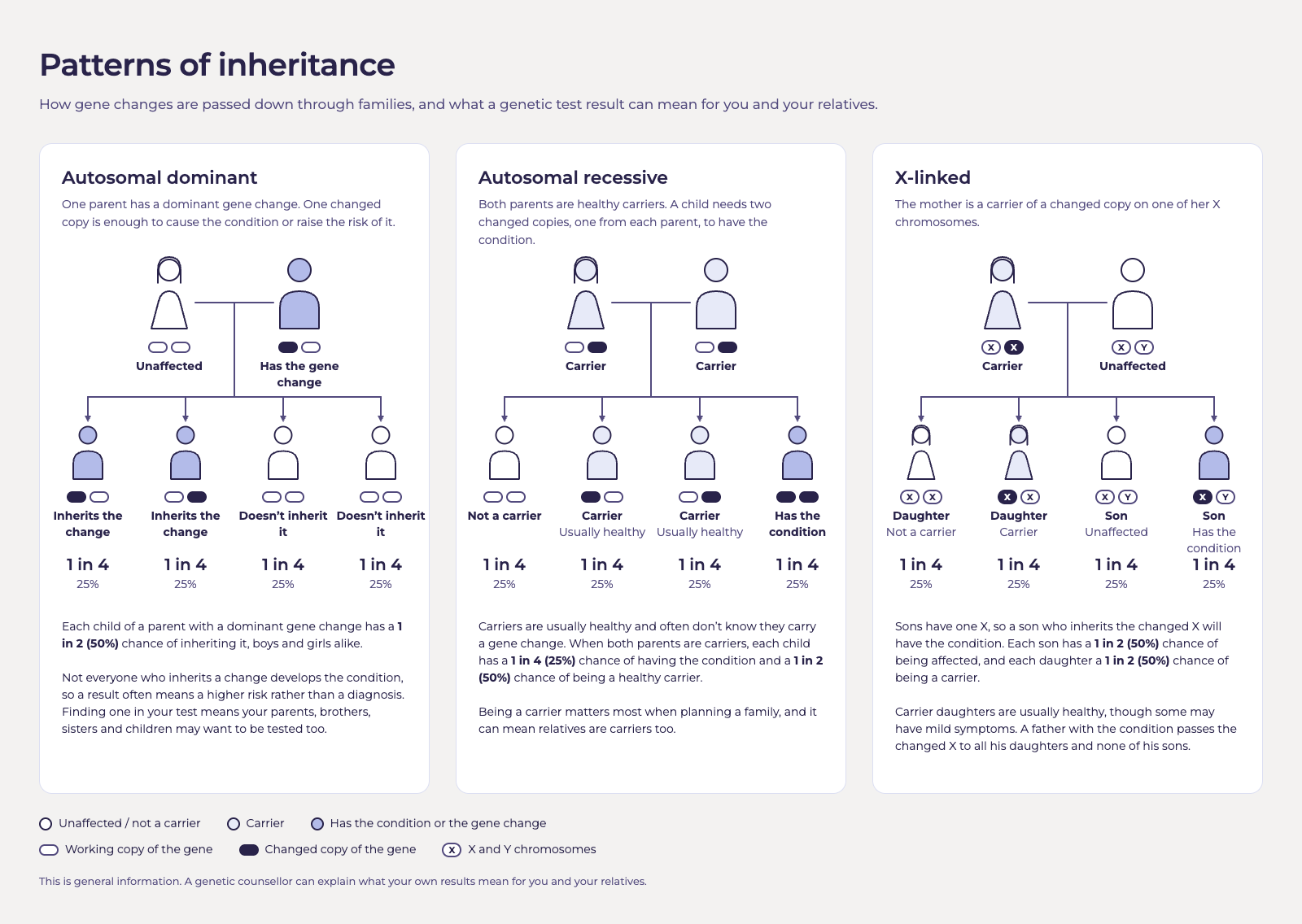
These terms describe how many copies of a variant someone has. Heterozygous means the variant is present in one copy of the gene, while homozygous means it is present in both copies. Hemizygous is used when there is only one copy of a gene to begin with, as with genes on the X chromosome in males. For a recessive condition, being heterozygous usually means someone is a healthy carrier, whereas for a dominant condition, one copy can be enough to increase the chance of the condition.
What do dominant, recessive and X-linked mean?
These describe how a condition is passed on. In dominant inheritance, one copy of a variant is enough, so every child of a person with the variant has a 50% chance of receiving it. In recessive inheritance, a child is affected only after receiving a variant from both parents, so two carriers of the same condition face a one-in-four chance in every pregnancy. X-linked conditions involve genes on the X chromosome and usually affect males more often, because they have only one X chromosome.
What is a carrier?
A carrier has a variant linked to a genetic condition but does not usually have symptoms. Carrier status in parents matters mainly for their children, because a couple who carry variants in the same gene, or a woman who carries certain X-linked variants, may have a higher chance of having a child with the condition. For a small number of genes, carriers can have some health effects of their own, and these are discussed during genetic counselling. Our article on what it means to be a carrier explains more.
What are penetrance and variable expressivity?
Penetrance is the chance that someone with a particular variant will actually develop the related condition. Some variants have high penetrance, while for others many people never develop signs at all. Variable expressivity means that people with the same variant can be affected in very different ways, even within one family. Both explain why a positive result describes an increased chance rather than a certainty.
What is the difference between germline and somatic variants?
Germline variants are present from conception, are found in every cell and can be passed to children. Somatic variants arise during life in particular cells, such as in a tumour, and are not inherited. Most tests for inherited conditions, including carrier screening and proactive screening, look for germline variants.
How is a variant written on a report?
Variants are usually written using an international naming system that describes exactly where a change sits. A description beginning with c. refers to the change in the coding DNA sequence, and one beginning with p. describes the expected effect on the encoded protein.4 For example, the most common variant linked to cystic fibrosis is written as c.1521_1523del in the CFTR gene, which describes the deletion of three DNA letters, and as p.(Phe508del) for the protein, meaning one building block (phenylalanine at position 508) is missing. These codes allow laboratories and doctors to identify the same variant precisely, which is essential when relatives are later tested for it.
What terms appear on a carrier screening report?
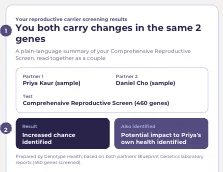
Carrier screening reports often include a few extra terms. Residual risk is the small chance that someone is still a carrier after a negative result, because no screen detects every variant. Couples screened together may also receive a combined couple report, which shows whether both partners carry variants in the same gene. Carrier screening at Genotype Health comes in two forms: Core Carrier Screen, covering the conditions Medicare funds, and Lineova, which examines 461 genes. Lineova Duo provides individual reports for each partner plus a couple report, and ancestry panel options make results more relevant for people of Southeast Asian, Middle Eastern and North African, or Ashkenazi Jewish heritage.
What are secondary findings, re-analysis and reclassification?
A secondary finding is a variant that turns up by chance, outside the reason for testing, yet may still matter for health, such as one linked to an inherited heart or cancer condition. These are more likely with broad tests such as exome or genome sequencing, and people are usually asked beforehand whether they want to know about them.5 Re-analysis means looking again at existing test data as knowledge grows, which can sometimes find an answer without a new sample. Reclassification happens when new evidence changes how a variant is classified, for example from uncertain to benign. Because classifications can change over time, it is worth keeping reports and asking whether an update is available if circumstances change.
“A genetic report can look technical, but every term on it has a plain-language meaning. Our job is to walk people through their result, explain what it does and does not mean, and help them decide on the next steps that are right for them and their family.”
Dr Mona Saleh, Head Genetic Counsellor, Genotype Health
What should someone do after receiving their report?
The most useful step is to talk the result through with a genetic counsellor or doctor before making any changes to medical care. At Genotype Health, genetic counselling is included before and after testing, and the detailed medical and family history collected at the start helps the counsellor interpret results quickly. If a pathogenic or likely pathogenic variant is found, the counsellor can explain what it means, recommend which relatives may benefit from testing and support the conversation with family. Relatives can then have Genotype Health’s Family Variant Testing, which looks for as many as ten known variants in one test, using a personal digital referral link the counsellor prepares for each of them. Some families may qualify for funded testing at a public genetics service (see the directory of genetic services across Australia).6 A screening result is not a diagnosis, and symptoms should always be checked by a doctor.
Have questions about a genetic test report?
Find out more about Genotype Health’s tests: Explore carrier screening or Explore proactive screening.
Need help understanding a result? Speak with a genetic counsellor.
More questions about genetic test reports
Can a genetic test result change over time?
The DNA does not change, but the interpretation of a variant can. As evidence grows, a variant may be reclassified, which is why laboratories sometimes issue updated reports.
Why does my report list genes where nothing was found?
Reports list the genes that were analysed so it is clear what the test covered. A gene with no reported variant means no clinically significant variant was found in it.
Is a likely pathogenic variant treated differently from a pathogenic one?
Usually not. Both are generally managed in the same way, because likely pathogenic means there is strong evidence, more than 90% certainty, that the variant is linked to a condition.
Should relatives be tested if I have a variant of uncertain significance?
Not routinely. Relatives are usually only tested to help clarify an uncertain variant, and a genetic counsellor will advise whether this is useful.
Who can see my genetic test report?
Reports are confidential health information. They are shared with the person tested and the referring doctor, and can be shared with relatives or other health professionals only with consent. Read more about how we protect your genetic data.
What if I have a new partner?
Your chance of having an affected child depends on your new partner’s results. A Lineova Duo screen with your new partner would show whether they carry a pathogenic or likely pathogenic variant in the same genes as any variants you carry (plus fragile X syndrome, if your new partner has two X chromosomes).
Related reading
- Everything you need to know about genetic testing and counselling
- What makes a genetic test clinical-grade?
- Family variant testing: what to do when a relative has a confirmed genetic finding
- What is genetic counselling? A plain-language guide
References
- Richards S, Aziz N, Bale S, Bick D, Das S, Gastier-Foster J, et al. Standards and guidelines for the interpretation of sequence variants: a joint consensus recommendation of the American College of Medical Genetics and Genomics and the Association for Molecular Pathology. Genet Med. 2015;17(5):405–23. doi:10.1038/gim.2015.30
- MedlinePlus Genetics. What do the results of genetic tests mean? [Internet]. Bethesda (MD): National Library of Medicine; [updated 2021 Jul 28; cited 2026 Oct 9]. Available from: https://medlineplus.gov/genetics/understanding/testing/interpretingresults/
- Mersch J, Brown N, Pirzadeh-Miller S, Mundt E, Cox HC, Brown K, et al. Prevalence of variant reclassification following hereditary cancer genetic testing. JAMA. 2018;320(12):1266–74. doi:10.1001/jama.2018.13152
- den Dunnen JT, Dalgleish R, Maglott DR, Hart RK, Greenblatt MS, McGowan-Jordan J, et al. HGVS recommendations for the description of sequence variants: 2016 update. Hum Mutat. 2016;37(6):564–9. doi:10.1002/humu.22981
- NSW Health. Genomic testing information sheet [Internet]. Sydney: NSW Health; [updated 2025 Jun 4; cited 2026 Oct 9]. Available from: https://www.health.nsw.gov.au/services/Pages/nswhealth-genomic-testing-information-sheet.aspx
- Centre for Genetics Education. Genetic services [Internet]. Sydney: NSW Health; [cited 2026 Oct 9]. Available from: https://www.genetics.edu.au/SitePages/Genetic-Services.aspx