
What makes a genetic test clinical-grade? Accreditation, standards and what to look for

Recent Posts





Related Posts



Not all genetic tests are created equal. An ancestry kit bought online and a test ordered through a health service may both start with a saliva sample, but what happens next is very different.
If you’re going to make decisions about your health, your family or a pregnancy based on a result, that result needs to be accurate, properly interpreted and explained. That is what clinical genetic testing is designed to deliver. This guide explains what makes a genetic test “clinical-grade”, the accreditation and standards behind it, and what to look for before you choose a test. For a broader introduction, see everything you need to know about genetic testing and counselling.
Key takeaways
- A clinical-grade genetic test is accurate, interpreted to agreed standards, reviewed by qualified experts and supported by genetic counselling.
- Consumer DNA tests aren’t designed for medical use. In one study, 40% of variants in consumer raw data were false positives when retested in a clinical laboratory.
- Look for laboratory accreditation such as ISO 15189, NATA/RCPA, CAP or CLIA, and for variants classified using the ACMG/AMP guidelines.
- In Australia, home self-tests for serious diseases, including genetic markers of disease, can’t be supplied, so medically meaningful genetic tests are arranged through a health professional.
- Genotype Health’s tests are performed in accredited laboratories, report only pathogenic and likely pathogenic variants, and include genetic counselling.
What does “clinical-grade” mean?
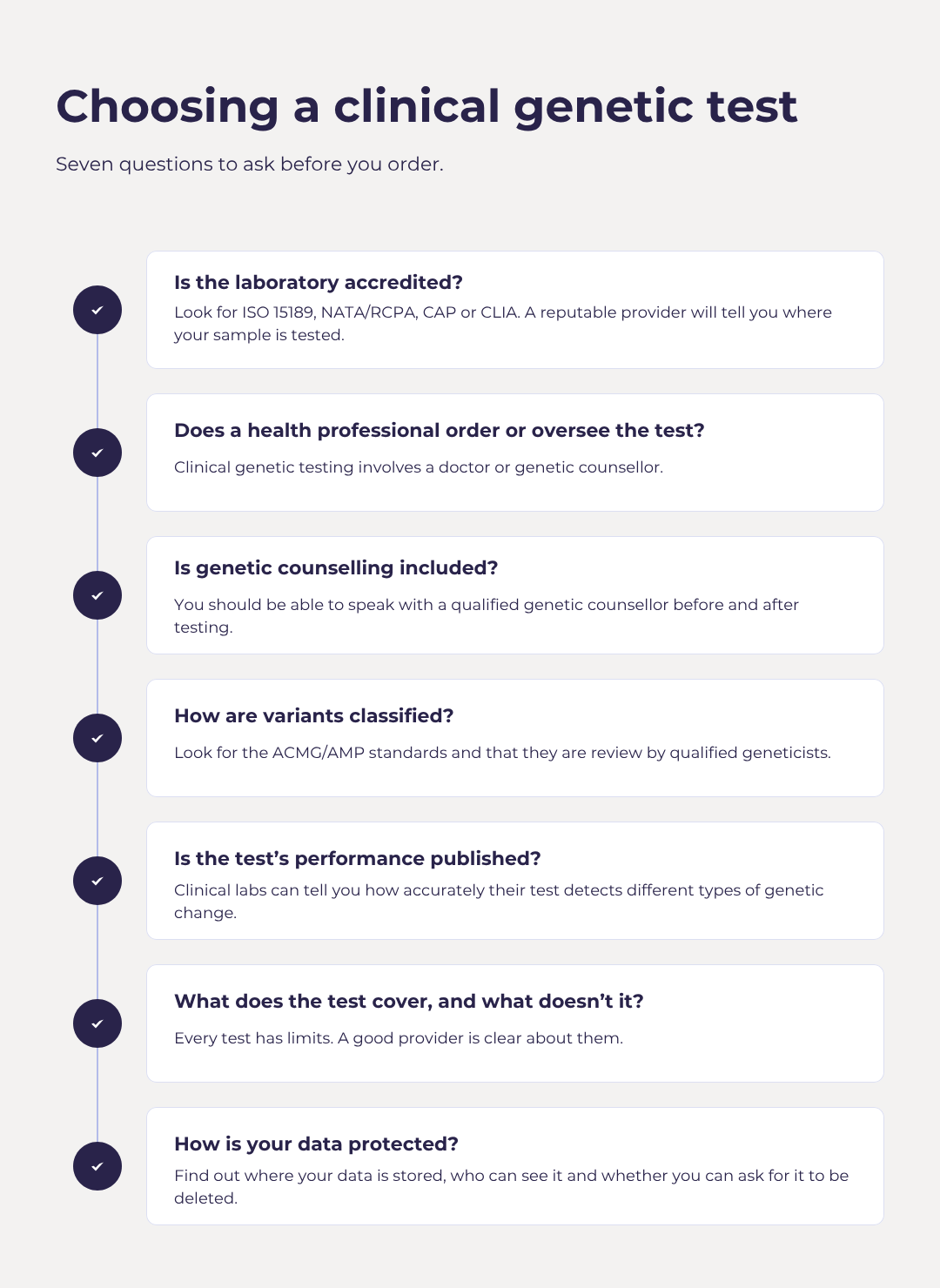
A clinical-grade genetic test is one that is reliable enough to guide medical care. That rests on four things.
It’s accurate. The laboratory has validated its methods and can show how well its test detects genetic changes. It also takes part in regular proficiency testing, where independent bodies send samples to check the lab gets the right answers.
It’s interpreted to an agreed standard. Finding a genetic change is only half the job. The lab must decide whether that change causes disease. Most clinical laboratories classify variants using the ACMG/AMP guidelines, which sort each variant into one of five categories: pathogenic, likely pathogenic, uncertain significance, likely benign or benign. Source
It’s reviewed by qualified experts. Results are checked and signed off by qualified molecular geneticists or pathologists before they are released.
It comes with clinical support. Genetic counselling before and after testing helps you decide whether a test is right for you and understand what a result means for you and your family.
Why this matters: the consumer test problem
Consumer DNA tests are designed mainly for ancestry or general interest. Some give customers their “raw data”, which people then run through third-party tools to look for health risks. A study in Genetics in Medicine found that 40% of variants reported in consumer raw data were false positives when retested in a clinical laboratory. Some variants flagged as “increased risk” were actually classified as benign by clinical labs. Source
That’s why any health-related finding from a consumer test should be confirmed by clinical genetic testing before you act on it.
Accreditation and standards explained
Accreditation means an independent body has inspected a laboratory and confirmed it meets strict quality standards. These are the main ones you’ll see.
ISO 15189. This is the international standard for the quality and competence of medical laboratories. It covers everything from staff qualifications and equipment to how samples are handled and results are reported. Source
NATA/RCPA accreditation (Australia). In Australia, pathology laboratories are accredited by the National Association of Testing Authorities (NATA) together with the Royal College of Pathologists of Australasia (RCPA). Labs are assessed against ISO 15189 and the standards of the National Pathology Accreditation Advisory Council (NPAAC). Source Accreditation is also the basis for approval as a Medicare pathology laboratory.
CAP and CLIA (United States). CLIA sets US federal quality rules for clinical laboratories, including quality control, staff qualifications and proficiency testing. CAP (College of American Pathologists) accreditation goes further, using detailed checklists for molecular genetic testing. Many international labs hold both. Source
European rules. In Europe, laboratories are accredited to ISO 15189 by national accreditation bodies, and diagnostic tests must meet the EU’s In Vitro Diagnostic Medical Devices Regulation (IVDR).
How Australia protects consumers
Australia regulates genetic testing more tightly than many countries. Since 2010, home self-tests for serious diseases, including genetic markers of disease, have been prohibited from supply. Source This doesn’t apply to testing arranged through a health professional. That is why medically meaningful genetic tests in Australia are arranged through a doctor or genetic counsellor.
How Genotype Health meets these standards
Every Genotype Health test is clinical genetic testing, built to the standards above.
Accredited laboratories. Our panel tests are performed by an accredited clinical laboratory in Europe. It is accredited to ISO 15189, accredited by the College of American Pathologists (CAP) and CLIA-certified, and its panel tests run on a CE-marked in vitro diagnostic device. Our Core Carrier Screen is performed by an accredited Australian laboratory. Read more about sending your sample overseas.
Proven performance. Our panels detect single-letter DNA changes with over 99% sensitivity, and include around 2,000 known disease-causing variants outside the coding regions of genes.
Expert interpretation. Variants are classified using the ACMG/AMP guidelines, and reports are prepared by PhD molecular geneticists. Only pathogenic and likely pathogenic variants are reported, so you won’t receive uncertain results that can cause unnecessary worry.
Genetic counselling at every step. Our AI genetics assistant, Tara, walks you through important pre-test information and consent. Our genetic counsellors review and approve every patient report, and you can speak with them whenever you need to.
Your data, protected. We store your reports securely in Australia, in line with Australian health information laws. See how we protect your genetic data.
Frequently asked questions
What is clinical genetic testing?
Clinical genetic testing is genetic testing performed in an accredited laboratory, interpreted to recognised standards and provided with support from health professionals. Its results are reliable enough to guide medical decisions.
Is a consumer DNA test the same as a clinical test?
No. Consumer tests are mainly designed for ancestry or general interest, and their raw data hasn’t been validated for medical use. Any health finding from a consumer test should be confirmed with clinical genetic testing.
Can a laboratory overseas be clinical-grade?
Yes. What matters is that the laboratory is accredited to recognised international standards, such as ISO 15189 and CAP. Many leading genetic laboratories serve patients around the world.
Do I need a referral from my doctor?
Not for our screening tests. Our clinical team oversees your test, and genetic counselling is part of the process. You can also ask your own GP to refer you, so they receive a copy of your results.
What is a variant of uncertain significance?
It’s a genetic change where there isn’t yet enough evidence to say whether it causes disease. Guidelines advise against making medical decisions based on these variants. Our screening tests report only pathogenic and likely pathogenic variants.
Is any genetic test 100% accurate?
No. Even the best clinical tests have limits, which is why accredited labs publish their performance and why genetic counselling is so important. Your genetic counsellor can explain what your test can and can’t tell you.
Is a screening test the same as a diagnostic test?
No. Genotype Health’s screening tests are performed to diagnostic quality, but a screening result is not a diagnosis of disease. Screening is for people without symptoms, to find out whether they have an increased chance of a condition or carry a variant they could pass on. A diagnostic test is a targeted test for someone with symptoms or a known family condition, and is generally arranged on referral from a specialist doctor. We are developing our diagnostic services and hope to launch them in early 2027.
Are Genotype Health’s tests covered by Medicare?
Our panel tests are performed by a laboratory in Europe, so they aren’t eligible for a Medicare rebate. Our Core Carrier Screen, performed by an accredited Australian laboratory, will be bulk-billed for patients who meet the Medicare criteria. We expect it to be available from December 2026.
How is the sample collected?
Genotype Health uses a simple cheek swab, also known as a buccal swab. The kit is posted to your home, and you return it by post, so there is no need to visit a collection centre.
How long do results take?
Results are usually available about four to six weeks after the laboratory receives your sample, depending on the test. Testing for a known family variant usually takes about four weeks.
What happens if my sample can’t be tested?
Occasionally, a sample doesn’t contain enough DNA to give a reliable result. This happens with around 1% of samples. If it happens to you, we will contact you about providing a new sample.
Choose a test you can trust
Your genetic information can shape important decisions about your health and your family’s future. You deserve results you can rely on, and people to help you understand them.
At Genotype Health, every test is clinical genetic testing: performed in accredited laboratories, interpreted to international standards and supported by our genetic counsellors.
Explore our proactive health screening and carrier screening tests, or chat with Tara to learn more.
Related reading
- Everything you need to know about genetic testing and counselling
- Sending your sample overseas: your questions answered
- Understanding your genetic test report: a guide to common terms
- How we protect your genetic data
Sources
- Standards and guidelines for the interpretation of sequence variants, ACMG/AMP, Genetics in Medicine, 2015
- False-positive results released by direct-to-consumer genetic tests, Genetics in Medicine, 2018
- ISO 15189 Human Pathology accreditation, NATA
- Understanding the rules for IVD self-tests, Therapeutic Goods Administration
- CLIA, laboratory-developed tests and FDA oversight