
Genetic testing and your insurance: what Australian law says (2026 update)

Recent Posts





Related Posts



For years, one question has held many Australians back from genetic testing: “Will this affect my insurance?” In 2026, the answer changed. From 8 October 2026, life insurers in Australia can no longer ask for, or use, your genetic test results when deciding whether to cover you or what to charge.
This guide explains what Australian law now says about genetic testing and insurance, in plain language. It covers health insurance, life insurance, what insurers can still ask about, and what to keep in mind before you test. For a broader introduction to testing, see everything you need to know about genetic testing and counselling.
Key takeaways
- From 8 October 2026, life insurers in Australia can’t ask for or use genetic test results, including your relatives’ results, when deciding whether to offer cover or what to charge.
- The ban covers death, TPD, trauma and income protection cover. Private health insurance has never been able to use genetic results.
- Insurers can still ask about symptoms, diagnosed conditions and family medical history. A screening result showing a genetic variant is not a diagnosis.
- Policies that started before 8 October 2026 keep their original terms. The protections apply to changes you agree to from that date, such as an increase in cover.
- If you think an insurer has broken the rules, you can complain to the insurer, then to AFCA, and report it to ASIC.
This article is general information only. It is not legal or financial advice. For advice about your own situation, speak with a licensed financial adviser or lawyer.
Private health insurance: your genetic test results don’t count
This is the simplest part. Private health insurance in Australia is community rated under the Private Health Insurance Act 2007. That means insurers must charge everyone the same premium for the same policy. They can’t assess your individual health risk, so they can’t use a genetic test result to refuse you cover or charge you more. Source
This has been the case for many years, and the 2026 changes don’t alter it. If your only concern is your health fund, a genetic test won’t affect it.
Life insurance: the new ban on using genetic test results
Life insurance works differently. It is risk rated, which means insurers assess each applicant. Until 2026, they were legally allowed to use genetic test results as part of that assessment. From 2019, an industry moratorium limited this, but only for cover below set amounts, such as $500,000 for death cover. Above those limits, insurers could still ask. Source
That has now been replaced by law. The Treasury Laws Amendment (Genetic Testing Protections in Life Insurance and Other Measures) Act passed Parliament on 1 April 2026 and received Royal Assent on 8 April 2026. The ban applies to life insurance decisions made on or after 8 October 2026. Source
What the ban covers
- All types of life insurance: death cover, total and permanent disability (TPD), trauma and income protection.
- No asking, no using: insurers can’t ask for, request or use your genetic testing information when deciding whether to offer cover, or on what terms, such as price, exclusions or conditions.
- No pressure to test: an insurer that asks or recommends you have a genetic test is treated as breaking the ban, even if you never take the test.
- Your relatives are protected too: the ban covers genetic tests taken by your blood relatives, as well as your own.
- Research participants are protected: results from genetic research studies are covered, as well as clinical tests.
You don’t have to tell them
For cover that starts, or changes you agree to, on or after 8 October 2026, you don’t have to disclose protected genetic information. Not mentioning it is not treated as a misrepresentation. You can still choose to share a result if it helps you, for example a result showing you don’t carry a family variant. The insurer needs your written consent, and can only use it if it doesn’t disadvantage you. Source
What about cover you already hold?
The new law looks forward, not back. A policy that started before 8 October 2026 keeps the terms it was issued on. The protections only reach that policy when you and your insurer agree to change it, such as an increase in cover, an extension, or reinstating a policy that lapsed, and then only for that change. Automatic changes, like a yearly increase in your sum insured for inflation, don’t count. Source
A new test won’t affect cover you already have. Your duty to tell the insurer about your health ended when your policy started. You don’t need to tell them about a genetic test you have after that, and the result can’t be used against the cover you already hold. Source
Tests done before you took out your policy are judged under the old rules. The new disclosure protections don’t apply to an application made before 8 October 2026. Under the industry moratorium that ran from July 2019, you didn’t have to disclose genetic results if your total cover was no more than $500,000 death cover, $500,000 TPD, $200,000 trauma or $4,000 a month income protection. Above those limits, insurers could ask about genetic tests and use the results. Before July 2019, there were no limits at all. Source
If you were asked about a genetic test and didn’t disclose a result, the insurer’s options are limited. Unless the non-disclosure was fraudulent, an insurer can only cancel a life policy within three years of it starting, and only if it wouldn’t have offered you any cover at all. Within that time it may instead reduce the amount you’re covered for. Source
Existing loadings and exclusions stay unless your insurer agrees to change them. If you’re paying a higher premium, or have an exclusion, because of a genetic test result, it won’t be removed automatically. You can ask your insurer to review it. The ban applies to any decision about a change from 8 October 2026, but the law doesn’t say existing terms must be removed, and it isn’t yet clear how insurers will handle these requests. Source
Thinking of replacing your policy? A new policy that starts on or after 8 October 2026 is fully protected, and earlier genetic results don’t need to be disclosed. But a new policy is assessed from scratch. Your age, current health and family history are all reconsidered, waiting periods start again, and the premium may be higher. Don’t cancel existing cover until a new policy has been accepted, and get advice first. Source
Your protections at a glance
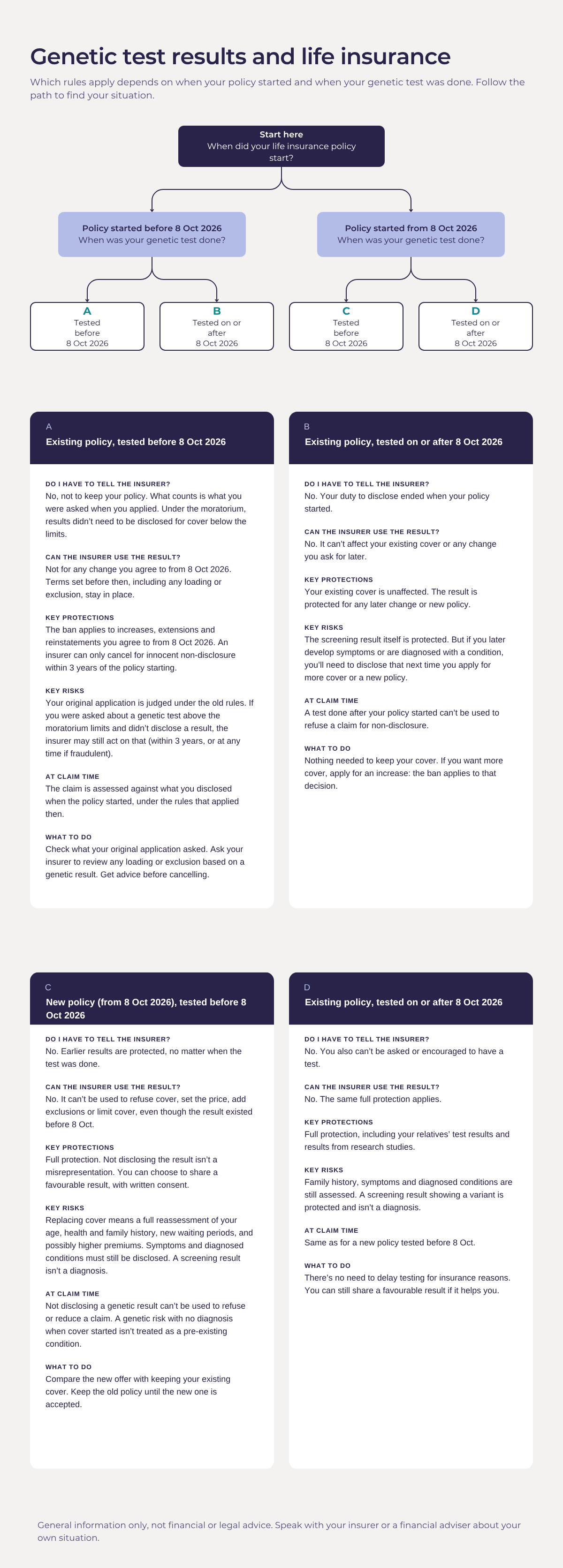
Screening and diagnostic tests: a screening result that shows a genetic variant is protected, because a variant is not a diagnosis of disease. Diagnostic testing is used when someone already has signs or symptoms. Insurers can still ask about those symptoms and any diagnosed condition, whether or not a genetic test helped confirm it. Whatever your situation, answer questions about symptoms, diagnosed conditions and family medical history honestly. Source
What life insurers can still ask about
The ban protects genetic test information. It doesn’t stop insurers asking about your health in other ways. They can still consider:
- Signs and symptoms you have now or have had.
- Diagnosed conditions, once a condition has shown signs or symptoms.
- Family medical history, such as a parent diagnosed with a disease.
The difference matters. “My mother was diagnosed with breast cancer at 45” can still be asked about. “My sister tested positive for a BRCA1 variant” cannot.
There is one important extra protection. Under regulations made in September 2026, a diagnosis made before any signs or symptoms appear is still protected. For example, someone whose screening test finds a Lynch syndrome variant, but who has no cancer or symptoms, is protected. Source
Screening tests and diagnostic tests
The ban treats these two kinds of genetic test differently because they answer different questions.
Screening tests look for genetic changes in people who are well, to show whether they may have a higher chance of developing a condition in the future, or of passing one on to their children. Examples include proactive health screening and carrier screening. Screening tests are done to the same quality standard as diagnostic tests. But a result showing a genetic variant is not a diagnosis of disease. It is protected genetic test information, and you don’t need to disclose it.
Diagnostic tests are used when someone already has signs or symptoms, to find or confirm the genetic cause. Insurers can still ask about those symptoms and any condition you’ve been diagnosed with, whether or not a genetic test helped confirm it. The genetic test doesn’t add anything new to disclose, because the symptoms or condition were already something an insurer could ask about. Source
Insurance the ban doesn’t cover
The new law applies to life insurance only. Travel insurers aren’t covered by it, although it is uncommon for them to use genetic information. Source
Default insurance through your super fund usually isn’t individually assessed, so genetic tests weren’t part of that decision anyway. The ban becomes relevant when you apply to increase or add cover, because that’s when the insurer assesses you.
If you think an insurer has broken the rules
The ban has real teeth. The Australian Securities and Investments Commission (ASIC) enforces it, and insurers that break it face criminal offences and civil penalties of up to about $1.65 million. Source
If you think an insurer has asked for or used your genetic test information:
- Raise it with the insurer first through their complaints process.
- If it isn’t resolved, lodge a complaint with the Australian Financial Complaints Authority (AFCA). Its rules were updated from 8 October 2026 to cover these complaints.
- You can also report a suspected breach to ASIC.
Practical tips before you test
- Don’t let insurance fears stop you. For most people, the law now removes the main reason to delay a genetic test that could help their health or their family’s. We address other common worries in myths and fears about genetic testing.
- Keep your existing policy in mind. The ban applies to any increase or change you agree to from 8 October 2026. Don’t cancel a policy you already hold without advice: a new policy is protected from genetic results, but everything else is reassessed.
- Answer health questions honestly. You must still disclose symptoms, diagnoses and family history when an insurer asks.
- Get advice if your situation is complex. A licensed financial adviser can help if you hold large policies or are unsure what applies to you.
- Talk it through with a genetic counsellor. Insurance is a normal part of pre-test counselling. At Genotype Health, our genetic counsellors are happy to answer your questions before you decide. Book a genetic counselling consultation.
Frequently asked questions
Will a genetic test affect my private health insurance?
No. Private health insurance is community rated, so your health fund can’t use a genetic test result to refuse you cover or charge you more. This hasn’t changed. Source
I already have life insurance. Do I need to tell my insurer about a genetic test I have now?
No. Your duty to tell the insurer about your health ended when your policy started. A test you have after that can’t be used against the cover you already hold. Source
I had a genetic test before I took out my current policy. Am I protected?
It depends on what you were asked when you applied. Policies that started before 8 October 2026 are judged under the rules that applied at the time. Under the industry moratorium, you didn’t have to disclose results if your total cover was within the set limits, such as $500,000 death cover. Above those limits, insurers could ask. If you’re unsure what your application asked, check your policy documents or ask your insurer or adviser. Source
My premium was increased, or an exclusion added, because of a genetic test result. Can I get that removed?
Not automatically. You can ask your insurer to review it, and any decision it makes about changing your policy from 8 October 2026 falls under the ban. But the law doesn’t say existing terms must be removed. Source
Should I cancel my old policy and take out a new one?
Not without advice. A new policy is fully protected from genetic test results, but everything else is reassessed, including your age, current health and family history. Waiting periods start again and the premium may be higher. If you do switch, keep your old policy until the new one has been accepted. Source
Can a life insurer ask if I’ve had, or plan to have, a genetic test?
No. Insurers can’t ask about genetic tests, ask for results, or recommend that you have a test. Source
A relative tested positive for a genetic variant. Do I have to tell my insurer?
No. Your relatives’ genetic test results are protected too. Insurers can still ask about conditions your relatives have been diagnosed with, such as a parent who had bowel cancer. Source
My screening test found a genetic variant. Is that a diagnosis I have to disclose?
No. A screening test looks for genetic changes that could increase your chance of developing a condition in the future. Screening tests are done to the same quality standard as diagnostic tests, but finding a variant is not a diagnosis of disease. The result is protected genetic test information, so you don’t have to disclose it and an insurer can’t use it. Regulations made in September 2026 also confirm that results for conditions such as Lynch syndrome stay protected while there are no signs or symptoms. Source
What about diagnostic genetic tests?
A diagnostic test is used when someone already has signs or symptoms, to find or confirm the genetic cause. The ban doesn’t stop insurers asking about your symptoms or a condition you’ve been diagnosed with, and you must answer those questions honestly. That applies whether or not a genetic test helped make the diagnosis. The genetic test doesn’t create anything new to disclose: the symptoms or condition were already something an insurer could ask about. Source
Can I use a good result to get better terms?
Yes. You can choose to share a result, for example one showing you don’t carry a variant that runs in your family. The insurer needs your written consent and can only use it in a way that doesn’t disadvantage you. Source
Does the ban apply to insurance through my super fund or to travel insurance?
The ban covers life insurance held through super. Default cover usually isn’t individually assessed, so the ban matters most when you apply to increase or add cover. Travel insurance isn’t covered by the new law. Source
What can I do if I think an insurer has broken the rules?
Complain to the insurer first. If that doesn’t resolve it, you can go to the Australian Financial Complaints Authority (AFCA). You can also report a suspected breach to ASIC. Source
Should I wait to sort out my insurance before having a genetic test?
For most people, there’s no longer any need to wait because of the genetic test result itself. If you have questions about your own situation, our genetic counsellors can talk them through with you before you decide, and a licensed financial adviser can help with your cover.
Does the ban apply if my genetic test was done overseas?
Yes. The ban covers genetic testing information in general, not only tests performed in Australia, so a result from a laboratory overseas is protected in the same way. Read more about sending your sample overseas. Source
What if an insurer finds out about my genetic result anyway?
It still can’t use it. An insurer can only take a genetic test result into account if you chose to share it yourself, gave written consent, and its use doesn’t disadvantage you. In any other case, the result must not affect the insurer’s decision. Source
Will the ban be reviewed?
Yes. The law requires a review after every fifth anniversary of the ban starting, to check that it is working as intended and has no unintended consequences. The report must be tabled in Parliament. Source
The bottom line
When it comes to genetic testing and insurance in Australia, 2026 marks a turning point. Health insurers have never been able to use your results. Now, life insurers can’t either. You can make decisions about genetic testing based on what’s right for your health and your family, without worrying about your cover.
Related reading
- Everything you need to know about genetic testing and counselling
- How we protect your genetic data
- Myths and fears about genetic testing
- Medicare funding for genetic testing in Australia
Sources
- Legislation passed to ban the use of adverse genetic testing results in life insurance, Treasury Ministers, 1 April 2026
- Treasury Laws Amendment (Genetic Testing Protections in Life Insurance and Other Measures) Act 2026, Federal Register of Legislation
- The use of genetic testing results in life insurance, Actuaries Institute
- Genetic testing and life insurance: what changes on 8 October 2026, Véurr Financial Planning
- Genetic testing results now protected from life insurers, Law Society Journal
- Genetic testing ban for life insurers now in force, Insurance Business Australia
- Life insurers can no longer use genetic test results against you, Money magazine
- Genetic Testing and Life Insurance, Human Genetics Society of Australasia
- Genetic Testing and Life Insurance, Genomics Australia
- Moratorium key facts (updated September 2023), Financial Services Council
- Insurance Contracts Act 1984, section 29 (life insurance), AustLII
- Genetic testing ban news, 23 June 2026, PPS Mutual
- The prohibition on adverse genetic testing in life insurance, Clyde & Co